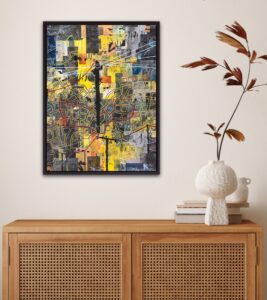
So much of my art stems from curiosity, a need to know details and a willingness to jump down rabbit holes. The Eruvim collection is no different.
The origin of the idea
One day I was pottering in the studio doing menial tasks that didn’t require much concentration and watching You Tube videos. When the series finished, I noticed an advert for a video about the ultra-orthodox Jewish community in Melbourne. I idly clicked to watch and at some point, the camera showed a small post low down to a wall, which the city guide identified as an eruv (עֵרוּב) marker. This intrigued me. I knew that an eruv was a symbolic legal boundary which allows the orthodox community to carry items within its boundaries on Shabbat and still be within the laws about not working on that special day. I thought however that eruvim were always marked by wires high up on telegraph poles. This small detail, totally irrelevant to my daily life, stuck in my mind and I couldn’t help but do some research.
It is not unusual for me to go down these chains of moving from one fact to another then through some personal interpretation and reflection towards a piece of art. Rarely, however, can I later remember the exact chain of events as I move so fast and am too engrossed in the topic at hand to make detailed notes until I get to the final ‘aha!’ moment that immediately proceeds the art work. Occasionally the art comes first and then the research follows (as in the Standing at Sinai Series ) but most of my art comes from contemplating ideas or world events and social issues. Increasingly, I am making a deliberate effort to respond to these stimuli in a way that draws together the various ‘parts of my life’ – law, art, Jewish study and writing, in an effort to feel more integrated in myself and to put more of myself into the work.
I do recall, however, a few days after the video, sitting on the patio in the summer sun reading a book. My husband commented on how engrossed I was and asked if it was a good novel. In fact it was a book by Adam Mintz about the minutiae of Jewish law concerning eruvim and the historical and contemporary disputes that arose in New York State and London about the building of the eruvim there. A slim well written volume, it was packed with social history cultural commentary and the legal niceties of American constitutional law and UK planning law and the creative thought it took to resolve the issues.
The process of creation
When I read something that fascinates me like this it is as if there are two tracks in my brain. One focuses on the academic, the words, the law and theory. That part wants to dig deeper, to understand, to see difference, draw connections and continue to pull on the multiple threads of information that form as I read. The other part of my brain, however, starts to travel on a different track. ‘How can I disseminate this information?’, it asks. ‘How can I make art about it?’ Is there a place I can write about this?” Ultimately both parts come together at the point of wondering: What do I have to say about this? How can I bring a fresh interpretation? How does it connect to other creative projects or study topics in my life right now?
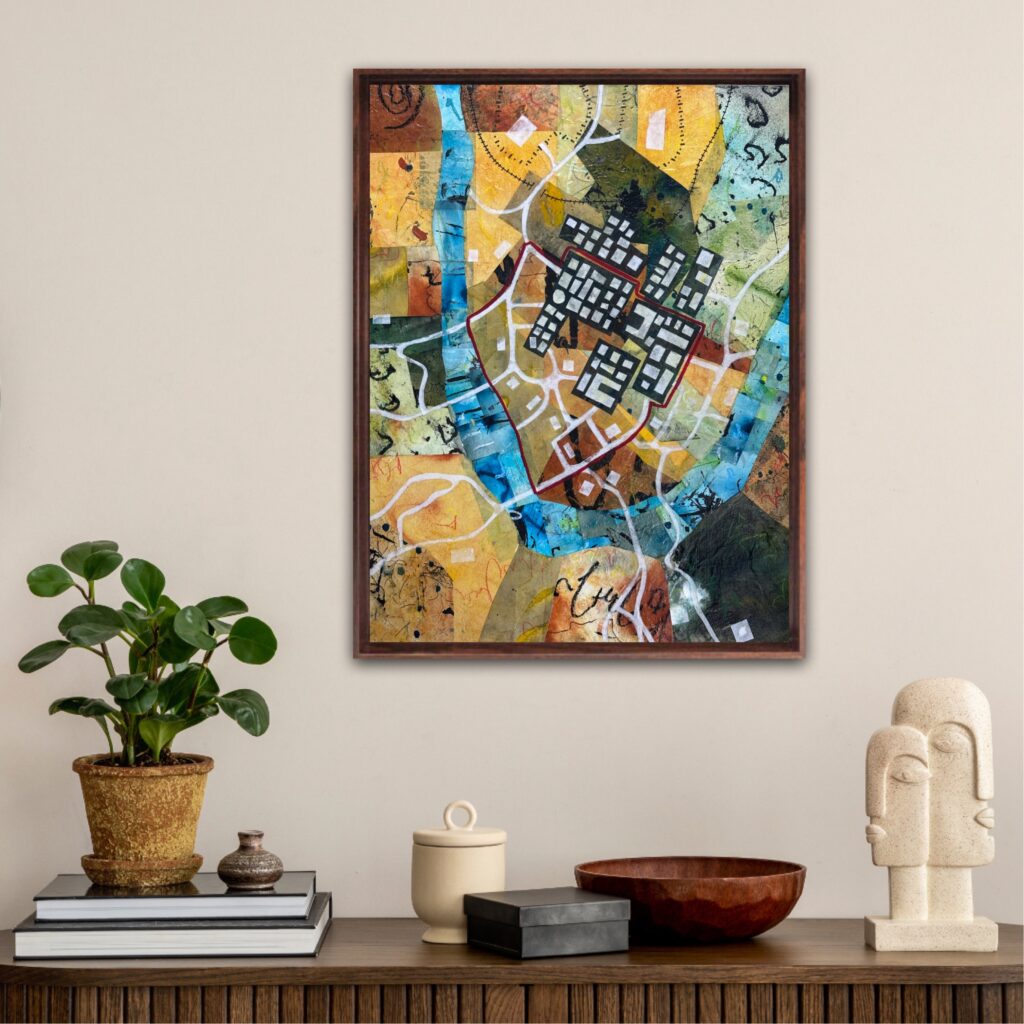
I was correct that many eruvim use telegraph poles or similar tall poles from which to hang the almost invisible wires that can (along with buildings or natural features) combine to form the technically acceptable boundaries of an eruv. Around the time I was reading we had our wifi upgraded. The engineer had to climb the telegraph pole outside my house which made me look up at it and see details I’d never noticed in fifteen years. We were about to travel to Montreal, a city with many Jewish bakeries. When looking for a map of them I stumbled on a map of the eruv there. I was taking a class in which I had made many painted papers with brushes I made myself and they were there right at hand ready to be used. Soon I was in the studio, sketching the pole outside the window and cutting up scraps and reassembling them in the way I love to do.
The meaning of the work
Working in this manual way always gives me time to think and so I came full circle as I drew and painted until my mind was lulled into a contemplative state in which I could think more about the relevance of this to me. It made sense that I would like the legal aspects, being a former Judge. However there are many laws in the Torah, much legal discussion in the Talmud. Why had this grabbed me now? On the face of it, the rules of eruvim were irrelevant to me. I live miles from the nearest eruv and my practice of Judaism is not such that I would use an eruv anyway. What was below the obvious surface level that was speaking to me in a voice so small I could not yet hear it?
I turned this question over in my mind and explored it in my journalling until I saw a connection between the eruvim and a particular struggle in my own life. Post October 7th 2023, I experienced a fracturing of my community as people struggled to respond to the Hammas attacks and then the wholesale destruction of Gaza, and more particularly struggled to stay in community with people who responded in a different way to them. Attempts were made to draw boundaries that excluded others, metaphorically and socially and, further away, literally and geographically.
I had been surprised when I read the book to read that there were so many objections to an eruv. They had always seemed to be to me so visually unobtrusive, so culturally harmless yet helpful to others that they seemed utterly benign. Yet they spark concerns that divisions are being drawn. In the UK people worry on the one had about the ‘ghettoisation of the area’ and consequent house price fluctuations (some say they will become unaffordable some say houses will become less valuable!) In the US the debate was more concerned with constitutional law and which groups were entitled to have religious symbols in public domains while others were not. Some Orthodox rabbis advocated for an eruv on the basis that would assist their congregations to observe Shabbat. Others refused to endorse one fearing the leniency it introduced would in fact encourage people to break the Shabbat traditions. I learned much about how many more responses there were than mine and what underpinned those views.
Ultimately, however, an eruv in Jewish law is about extending the private domain into the public. it is a word that means ‘mixing’ as in the mixing of courtyards to provide one greater home. The Eruv not just a legal fiction. In some communities of observant people it enables the sick to use walking aids, the elderly to carry glasses so they can see their prayerbooks and participate in services, young mothers to carry nappy bags and bottles of milk so they can celebrate Shabbat with friends.
As I cut paper up and stuck it back together to make something better, I thought a lot about the way in which we can hold a community together and the way we can respect views we don’t agree with.
On one level, these pieces are images of telegraph poles or imagined aerial views of villages with boundaries superimposed. On another level they are about the importance of a social ‘map’ to define who we are as a community or society and a personal ethical map of what we can and cannot tolerate or endorse and where we place our boundaries. They are also an invitation to think about who we can draw into community and the benefits of doing so rather than seeking to exclude and deny human needs because people are slightly different to us.